
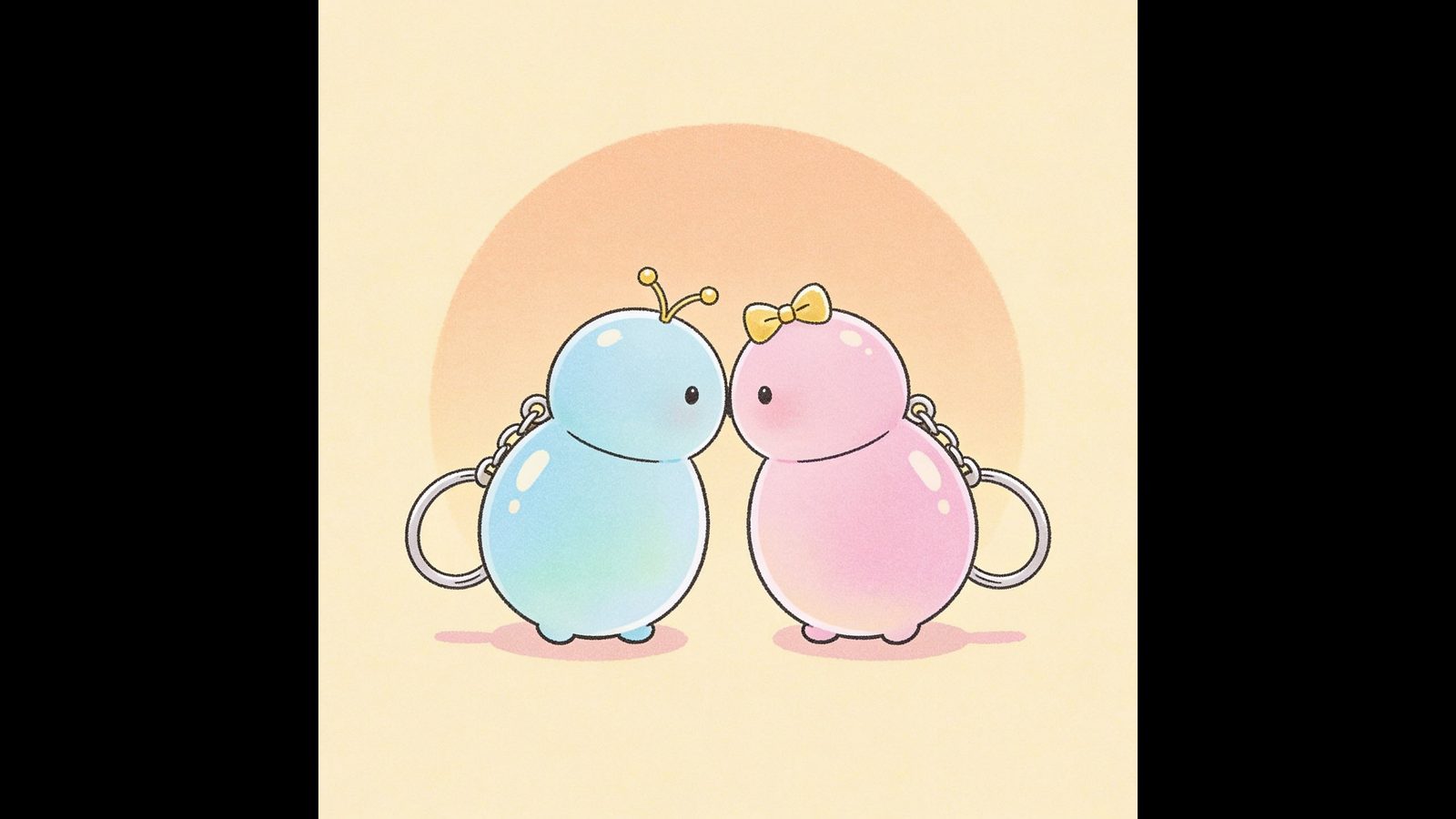
Before your Tamagotchi could inherit a trait, before eggs carried a parent's genes, there was a boy keychain and a girl keychain that would rather literally click.
By late 1997 the original Tamagotchi was everywhere, and Bandai had already learned that people didn't just want to raise a pet — they wanted to connect them. That urge produced one of the strangest, sweetest devices in the whole family line: the Osutchi and Mesutchi, a matched pair released in Japan that December.
Two halves of one toy
Osutchi (the boy) and Mesutchi (the girl) were sold as separate handhelds, each with its own little character to raise. If you owned just one, it was a perfectly normal virtual pet — feed it, play with it, clean up after it. But buy both, or find a friend with the other half, and the real magic switched on.
The two devices were made so their shells literally snap together — the tops interlock — and an adult, well-cared-for pair can then fall in love and raise a child together. Connect them at the right moment and your two pets start a family, and that new generation carries traits from both parents. It was the first breeding and marriage mechanic in Tamagotchi history, years before today's gene and heredity systems.
Why it mattered more than it looks
The OsuMesu (the nickname collectors still use) set the template for almost every Tamagotchi family mechanic that came after. Family trees, marrying your pet off, raising a baby that resembles its parents — all of that traces back to these two interlocking keychains. Bandai also leaned all the way into the romance: six styles shipped, three Osutchi and three Mesutchi, sold as colour-coded matched pairs so you could find your boy's girl and vice versa.
It was a clever piece of social design disguised as a toy. The original Tamagotchi's most famous draw was that it needed you constantly. The OsuMesu went a step further — the best things your pet could do required finding another person with the matching half. Love, apparently, was the original Tamagotchi multiplayer.
Stuck in (and out of) time
The pair stayed a Japan-focused release, and because you really needed two of them to see the heart of it, they've remained a collectors' curiosity rather than a household name. That's part of their charm. When you meet someone who knowingly smiles at the word "OsuMesu," you've found a truly deep-cut fan.
If you look closely at how modern Tamagotchis pass down looks and traits from parent to baby, you're seeing the distant echo of two little keychains that clicked together on a December commute in 1997. That's worth a nostalgic nod. We keep the family history live over at https://stacksignal.fdhcl.com if you're in a Tamagotchi rabbit-hole mood.