
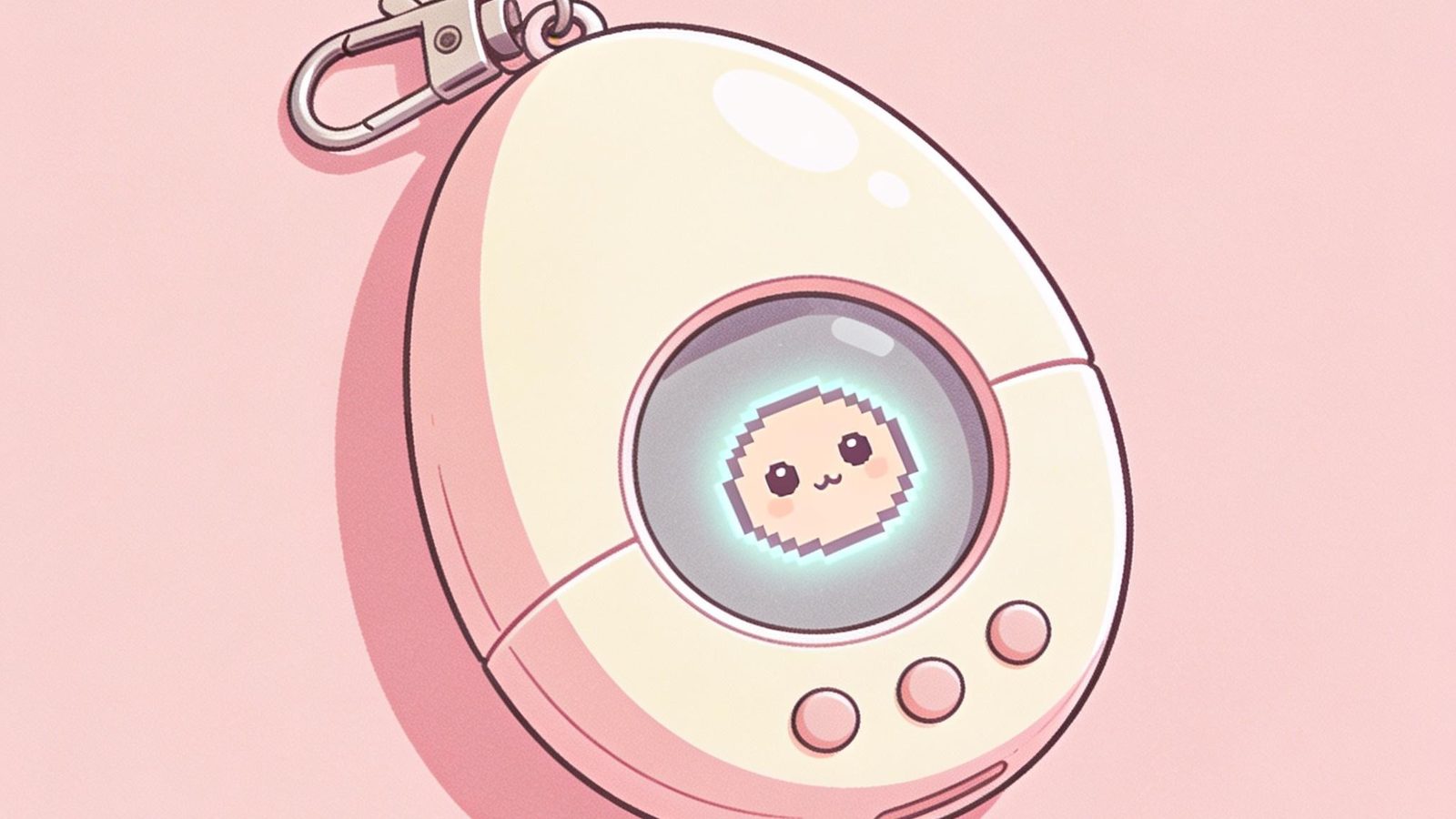
Long before it was a franchise, it was a piece of hardware. A keychain-sized egg, plastic and faintly beige, with three face buttons and a grayscale LCD that glowed green. No speaker to speak of, no color, no touch screen. Just a tiny digital creature living inside, dependent on you for everything.
That is the classic Tamagotchi. To hold one now is to feel how much the idea did with so little.
Two siblings, one shell
Bandai shipped the original egg in two versions. The first, sold in Japan on November 23, 1996 as "Generation 1" (and in the US on May 1, 1997), featured Mametchi as its top household name and a direction-guessing minigame. The second, the P2, arrived in Japan in February 1997 with Mimitchi in charge and a Number guessing game instead. Bandai would later name them Generation 1 and Generation 2 — a tidy retroactive label for a pair that were, for most kids, just "my Tamagotchi."
Physically they were near twins: three buttons (A, B, C), a small reset on the back, and that grey dot-matrix screen. The buttons did the utilitarian things — menus, scroll, select — but the magic was never in the buttons. It was in the loop they put you inside.
The care loop
You set the clock, and the egg wiggled on screen. Inside five minutes it hatched, and then it was real. You fed it — a meal or a snack. You cleaned up the droppings it left behind. You gave it medicine when it sickened, and scolded it to build discipline when it misbehaved. You played games to lift its happiness. Two meters, named Hungry and Happy, each held four hearts you worked to keep full.
Neglect had teeth. Let it go hungry, ignore the mess, and it got sick — or worse. Death was a real, quiet event, darkly funny in retrospect and genuinely upsetting at the time. The recovery was gentle: press A and C together and a fresh egg appeared, game over turned into round two.
The cast
The creature pool was small and enduring: Mametchi, earnest and dependable. Ginjirotchi. Mimitchi. Kuchipatchi. Nyorotchi, and Tarakotchi. These were not deep characters — they were a handful of pixels and a personality archetype each — but that was enough. Kids argued about which one they raised and why, and decades later these names still carry instant recognition.
Why it never died
The classic model refused to fade. For the franchise's twentieth anniversary, on November 23, 2017, Bandai re-released faithful replicas — the line collectors call "Oritama." Then, for twenty-five years in 2021, they revived the Tamagotchi Original line once more. By 2025, more than 98 million Tamagotchis had sold.
The remarkable thing is not the sales. It is that a single-purpose, four-letter-meters gadget still feels complete. No updates, no subscriptions, no cloud. An egg, a heartbeat, and your attention. That devotion outlasted the toy aisle — it became memory, then artifact, then icon. And it is still hatching.
For current coverage from our sister outlet, see https://hermesnews.fdhcl.com